One of the most common things adults say is some version of "I wish I'd started years ago." It usually comes with a second thought: maybe it's too late now.
The research on adults and older adults who train points the other way. This post walks through what studies have found about strength, balance, falls, thinking skills, and injury risk for people who start later in life.
What adults need anyway
Before getting to martial arts, it helps to know the baseline. The CDC's physical activity guidelines say adults need at least 2 days of muscle-strengthening activity each week, along with 150 minutes of moderate-intensity activity (or 75 minutes of vigorous activity).
For adults 65 and older, the CDC adds a third piece to the same strength and aerobic targets: activities that improve balance.
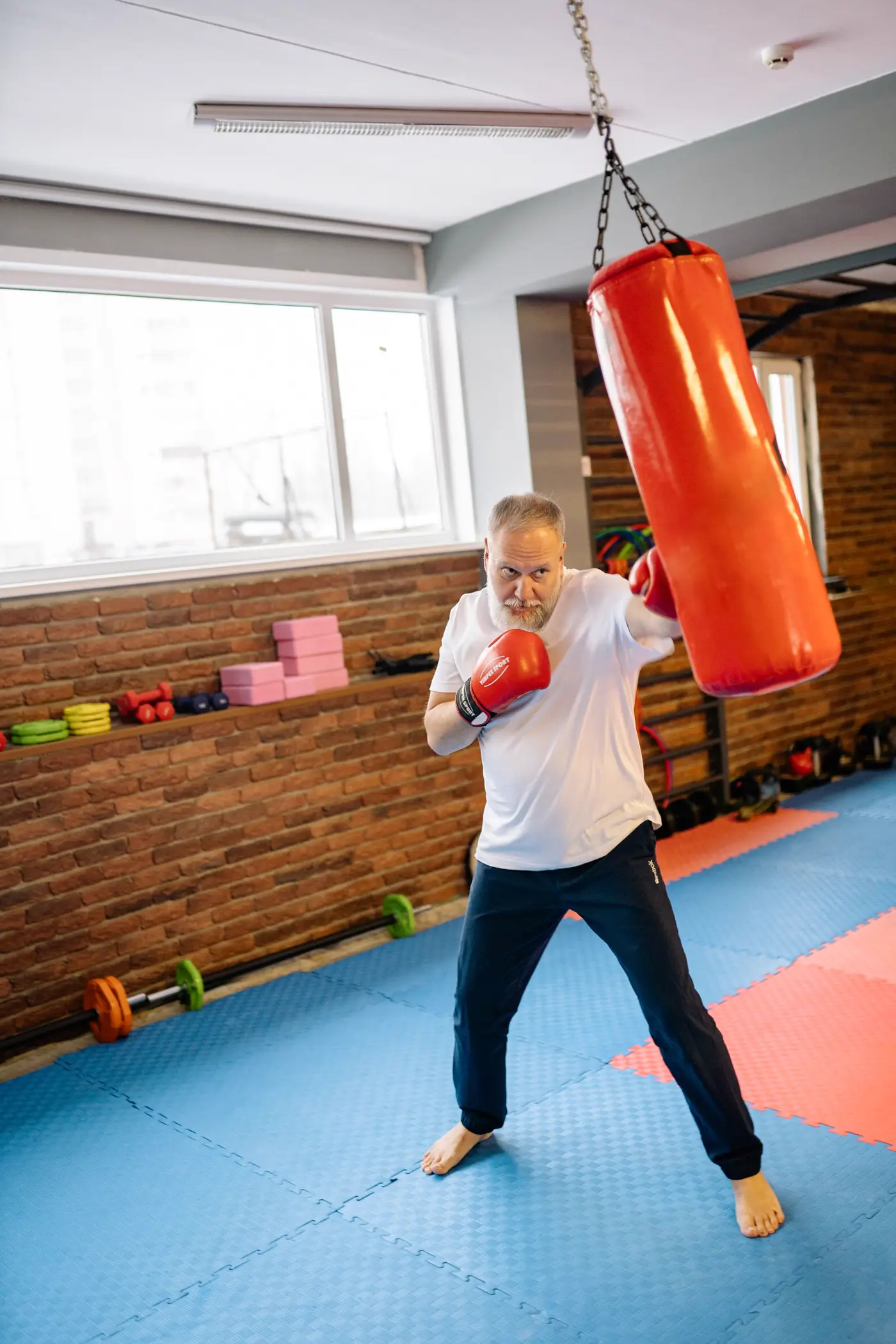
Strength, conditioning, and balance are what a good martial arts class trains every session. Stance work, footwork, and controlled movement are balance training. Pad work and drills are conditioning. Grappling and bodyweight work build strength.
Balance and falls
Falls are a bigger deal than most people realize. According to the CDC, over 14 million older adults, or 1 in 4, report falling every year, and falls are the leading cause of injury for adults 65 and older.
One of the strongest trials on this question tested tai ji quan, a martial art. In a 2018 randomized trial published in JAMA Internal Medicine, Li and colleagues enrolled 670 adults age 70 or older who had fallen in the past year or had impaired mobility. Participants took two 60-minute classes a week for 24 weeks in one of three programs: a therapeutic tai ji quan program, a multimodal exercise program (balance, aerobics, strength, and flexibility), or stretching.
At six months, the tai ji quan group had a fall rate 58% lower than the stretching group (incidence rate ratio 0.42). The multimodal exercise group also did better than stretching. The tai ji quan group had 31% fewer falls than the multimodal group. (The lead author disclosed that he receives a licensing fee for the program.)
Strength, mobility, and thinking skills
Other martial arts have been studied in older adults too, mostly in smaller trials.
A 2024 meta-analysis by Li and colleagues pooled 10 randomized trials of taekwondo with 227 participants aged roughly 66 to 74. Compared with control groups, taekwondo training was linked to significant improvements in a standard test of cognitive function, in handgrip strength, and in lean body mass, along with better cholesterol measures.
A 2025 systematic review and meta-analysis by de Mendonça and colleagues looked at 10 randomized trials of martial arts in elderly people. The pooled results showed a significant improvement in functional mobility for the martial arts groups. The authors were careful to rate the certainty of that evidence as low, because the studies were small and the raters weren't blinded.
That's a fair summary of the field. The direction of the findings is encouraging, and the studies are still small. Martial arts training looks like a reasonable way for older adults to work on strength, mobility, and balance. It isn't a cure for anything.
What about getting hurt?
This is the question behind a lot of hesitation, and it's a reasonable one. Injury risk depends heavily on what kind of training you do.
A 2026 study by Groessing and colleagues surveyed 112 mixed martial arts athletes about injuries over the previous two years. Across nearly 94,000 hours of training and competition, they reported 1.4 injuries per 1,000 hours. Non-competitive athletes reported significantly fewer injuries than competitive athletes, and fewer severe injuries. The most common injuries were joint sprains and ligament strains. This was a self-reported survey, so it has limits, but the pattern makes sense: hard competition carries more risk than steady training.
For adults starting out, that points to a few practical choices:
- Start with fundamentals and controlled drills before any live sparring.
- Train with partners and coaches who match intensity to your level.
- Build strength and mobility alongside skill work, since a stronger body handles training better.
- Treat sparring and competition as optional, not required.
If you have a heart condition, joint problems, a past injury, or you haven't been active in a while, talk to your doctor before starting a new training program. That conversation can help you choose the right starting pace.
Learning a new skill later in life
Many adults worry that they'll be slower to pick things up. Some will be, at first. But look at who was in the tai ji quan trial above: community-dwelling adults 70 and older who had already fallen or had trouble getting around. They weren't athletes. They trained twice a week for six months, and they fell far less often than the stretching group. Steady, structured practice did the work.
That matches how adult training is approached. At Adamas, adults start in Level 1 martial arts, which focuses on entry-level movement and fundamentals, and strength and conditioning that starts with bodyweight and light weights. Every new student begins with an assessment of movement, strength, and mindset, and the plan is built from there.
The bottom line
The research doesn't put an age limit on starting. What it shows is that older adults in structured martial arts programs have improved balance, mobility, strength, and in some studies thinking skills, and that a well-designed program can lower fall risk. Injury risk is real, and it's lower when training is controlled and non-competitive.
If you've been wondering whether you waited too long, the evidence suggests the better question is where to start. You can see the training options or request training to set up an assessment.
Sources
- Centers for Disease Control and Prevention. Adult Activity: An Overview (Physical Activity Guidelines).
- Centers for Disease Control and Prevention. Older Adult Activity: An Overview (Physical Activity Guidelines).
- Centers for Disease Control and Prevention. Older Adult Falls Data.
- Li F, Harmer P, Fitzgerald K, et al. Effectiveness of a Therapeutic Tai Ji Quan Intervention vs a Multimodal Exercise Intervention to Prevent Falls Among Older Adults at High Risk of Falling: A Randomized Clinical Trial. JAMA Internal Medicine. 2018.
- Li X, Bae JH, Lim B, et al. Impact of Taekwondo training on cognitive and physical function in elderly individuals: A comprehensive review of randomized controlled trials. Complementary Therapies in Clinical Practice. 2024.
- de Mendonça DLC, Raider Junior JM, da Silva LBB, et al. Benefits of martial arts on the functional capacity of elderly people: a systematic review and meta-analysis. Clinics (Sao Paulo). 2025.
- Groessing L, Starke V, Runer A, et al. How Risky Is Mixed Martial Arts? Injury Rates and Patterns in Competitive Versus Recreational Athletes. Healthcare (Basel). 2026.