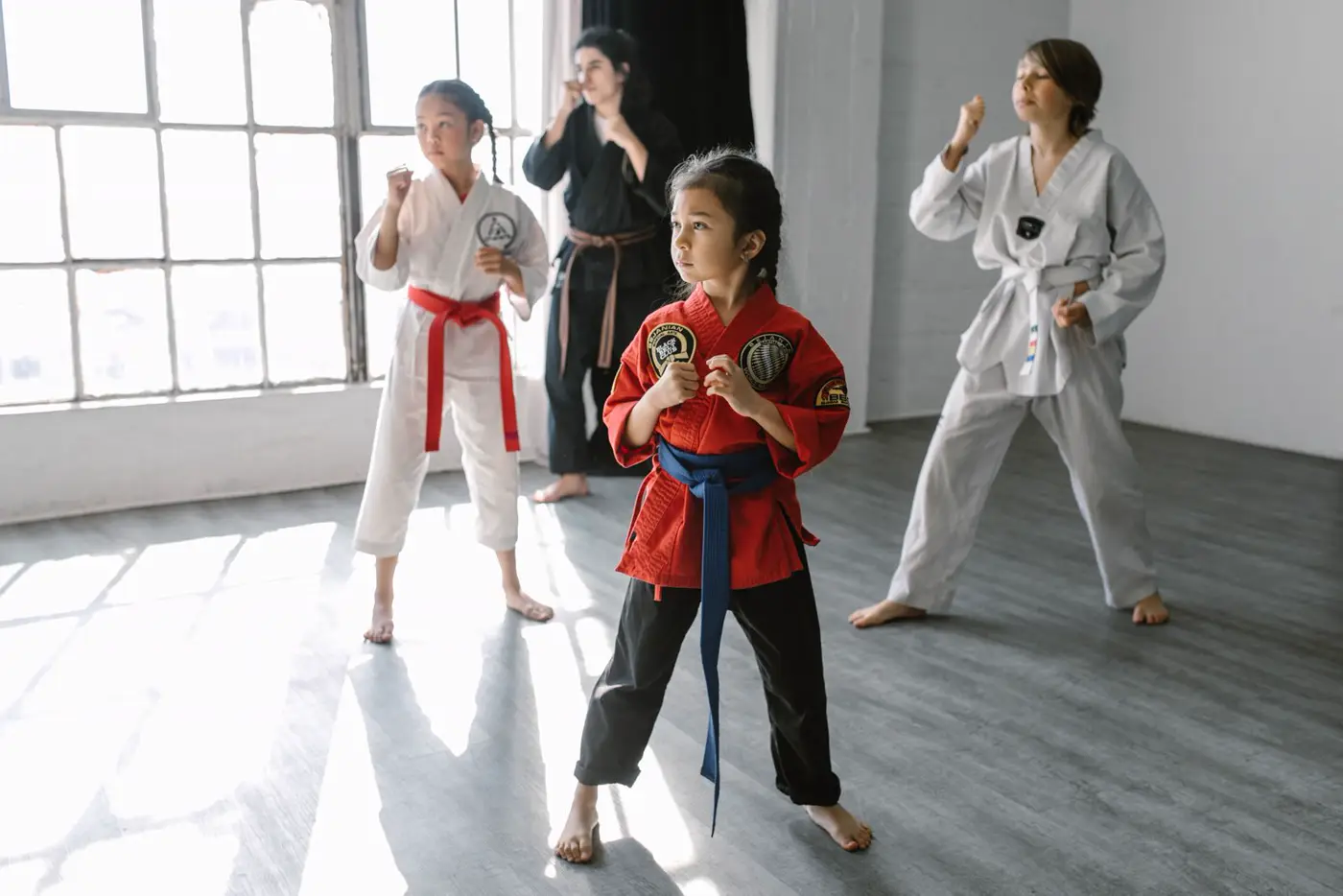
Parents often ask two questions. Will martial arts help my kid focus? And will it make my kid more aggressive?
Both are fair questions, and researchers have studied both. This post walks through what the evidence shows, where it's strong, and where it's still mixed.
Kids need movement, and a lot of it
The starting point is simple. The CDC recommends that children and teens ages 6 to 17 get 60 minutes or more of moderate-to-vigorous physical activity each day. That includes muscle-strengthening activity like climbing or push-ups at least 3 days a week, and bone-strengthening activity like jumping or running at least 3 days a week.
A martial arts class covers all three. The American Academy of Pediatrics, in a 2016 clinical report by Demorest and Koutures, notes that martial arts can give children and adolescents vigorous exercise that can improve overall physical fitness.
Self-regulation and focus
Self-regulation is a child's ability to manage attention, impulses, and behavior. It's one of the areas where martial arts research is most promising.
In a 2011 review in Science, Diamond and Lee looked at programs shown to improve executive functions in children ages 4 to 12. Executive functions include staying focused and giving a considered response instead of an impulsive one. Martial arts was on the list, along with aerobics, yoga, mindfulness, and certain school curricula. What the successful programs had in common was repeated practice that steadily increased the challenge. The review also found that children who started with weaker executive functions benefited most.
A 2022 randomized trial by Ng-Knight and colleagues tested a standard 11-week beginner taekwondo course with 240 children ages 7 to 11 at a U.K. primary school. After the course, children in the taekwondo group were rated by teachers as having fewer conduct problems and better attentional control. They also did better on a computer test of attention.
The same study is useful for what it didn't find. There were no effects on several other measures, including teacher-rated impulsivity, prosocial behavior, and working memory. So the honest summary is that a short taekwondo course helped attention and behavior in this trial, not every skill researchers measured. The children also rated the classes very positively, which matters if you want a kid to keep showing up.
A smaller 2024 trial by Parsamajd and Teymori randomly assigned 76 elementary school boys with behavior problems to karate kata training (twelve 60-minute sessions) or to their usual activities. The kata group showed significant improvements in attention and concentration and reductions in aggression, oppositional defiance, and social problems.
Does martial arts make kids more aggressive?
This is a common worry, so it deserves a straight answer from the data.
A 2020 meta-analysis by Moore and colleagues pooled 14 studies of martial arts training and mental health. Martial arts training had a small positive effect on wellbeing and a medium effect on internalizing symptoms (the kind linked to anxiety and depression). On aggression, the effect was minimal and not statistically significant.
A 2026 systematic review by Deng and colleagues looked specifically at children and adolescents across 11 intervention studies. They found no consistent effect in either direction. Results varied by martial art, program structure, and setting. Their conclusion was that any benefit appears to depend on the educational goals, the teaching, and the training context.
Put plainly: the research doesn't show that martial arts makes kids more aggressive. It also doesn't show that any martial arts class automatically makes kids less aggressive. How the class is taught matters.
What makes a good kids program
The research points to a few things worth looking for:
- Structure and progression. Diamond and Lee found that effective programs keep raising the challenge through repeated practice.
- Teaching that goes beyond technique. The Deng review suggests outcomes depend on the goals and guidance of the program, not just the punches and kicks.
- Controlled contact. The AAP report notes that noncontact forms and techniques may carry lower injury risk, while contact sparring and competition carry higher risk, especially blows to the head and choking or submission moves.
- A class kids enjoy. Benefits come from steady practice over time, and children keep going to things they like.
If your child has a health condition or a past injury, check with your pediatrician before starting a new sport.
How kids training is approached
At Adamas, kids train in their own age-appropriate classes, built on the same three pillars as the adult program: combatives, strength and conditioning, and nutrition and recovery. Like every new student, kids start with an assessment, and training builds from there in a clear progression.
The bottom line
The research on martial arts for kids is encouraging and still developing. Martial arts classes give children the kind of vigorous activity the CDC recommends. Controlled trials show improvements in attention and behavior, and the evidence doesn't support the fear that training makes kids more aggressive. The quality of the program makes a real difference.
If you're in The Highlands or nearby, you can request training for your child and training starts with an assessment.
Sources
- Centers for Disease Control and Prevention. Physical Activity Guidelines for Children and Adolescents (ages 6 to 17).
- Demorest RA, Koutures C; Council on Sports Medicine and Fitness. Youth Participation and Injury Risk in Martial Arts. Pediatrics. 2016.
- Diamond A, Lee K. Interventions shown to aid executive function development in children 4 to 12 years old. Science. 2011.
- Ng-Knight T, Gilligan-Lee KA, Massonnié J, et al. Does Taekwondo improve children's self-regulation? If so, how? A randomized field experiment. Developmental Psychology. 2022.
- Parsamajd F, Teymori S. Karate Kata training: A promising intervention for behavioral problems in elementary school children. Journal of Experimental Child Psychology. 2024.
- Moore B, Dudley D, Woodcock S. The effect of martial arts training on mental health outcomes: A systematic review and meta-analysis. Journal of Bodywork and Movement Therapies. 2020.
- Deng L, Ma X, Luo Q. Martial arts training and aggressive behavior in children and adolescents: a systematic review of longitudinal evidence and psychological processes. Frontiers in Public Health. 2026.